


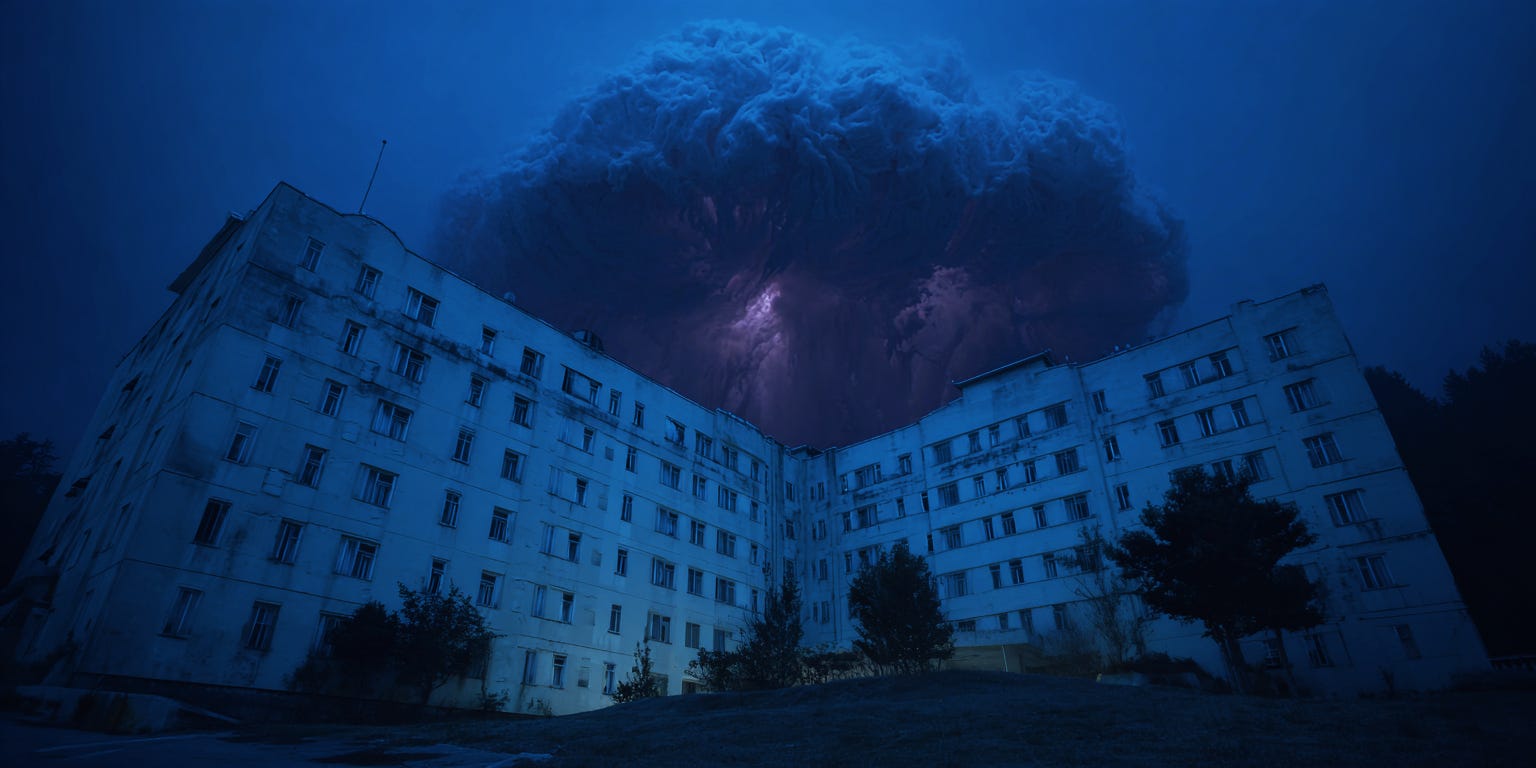
Willard had been brought to the middle of nowhere. Which, as it turned out, was located twenty minutes off Highway 52 and then south on Herricks.
On the way, sitting in the passenger seat of his friend Eric’s beat-up ‘86 Camaro, he’d been excited by the unknown night awaiting him. Eric had promised an alternative to the usual Friday night bar routine, and the surprise had grown more and more mysterious the further Eric drove, especially the long drive down the lightless road after exiting the highway. They didn’t speak for most of the drive, the only sound in the car being the occasional wet cough from Eric, who had been nursing a cold for the past week or so. They hadn’t passed a single car along the way, or even so much as a pedestrian out for a walk. So when Eric turned off the darkened road and into the even darker parking lot, more a garden of weeds and cracked blacktop, really, Willard had finally had enough of the silence.
“Where the hell are you taking me?” he asked. Looking through the windshield was like staring out the viewing port of a deep sea exploration vehicle, all inky shadow and occasional plant-life drifting past. Eric glanced over at him with a cryptic look on his face.
“You’ll see.”
No sooner had Eric said the words, a massive shape emerged from the darkness ahead. Lit by headlights, it was as towering and elaborate as the skeleton of some fallen, mythical beast, worn down by rain and reclaimed by the earth.
“What is that?” Willard asked, his voice barely escaping his throat. Eric answered by stopping the car, killing the engine, and hopping out before Willard could voice a complaint. Left alone in the quickly cooling car, he had little choice but to unbuckle his seatbelt and exit the vehicle.
The night had grown cold, thanks to a bitter breeze blowing across the weed-choked expanse. Willard joined Eric at the front of the car, where his friend was fidgeting with something that looked like a gun. As he grew closer, Willard saw with only mild relief that it wasn’t a gun—it was a flashlight.
He glanced back at the looming mass some hundred yards in the distance. Under the blue-yellow cast of the moon, and with his eyes adjusting to the dark, Willard was struck by the sight of a sprawling, abandoned building like he’d never seen. The concrete exterior was weather-worn and tired, with vines both alive and dead crawling up its face. Layers of graffiti covered much of its lower half, looking like old, regrettable tattoos.
Eric must have seen the confused look on Willard’s face, because he cleared his phlegmy throat, leaned in, and said, “You’ve never heard of St. Mary’s.”
Of course he had. St. Mary’s was infamous around those parts; a hospital built in the forties, state-of-the-art at the time, but poorly managed by crooked doctors and state officials. Over time it allegedly made most of its money by playing host to various medical studies that were, legally speaking, dubious in nature. Pharmaceutical companies and other powerful entities used the hospital as their private playground, from drug testing to psychological studies to, according to some rumors, government-funded human experiments. For years, locals shared warnings and inside jokes alike about the hospital, referring to it by a fittingly-disreputable nickname.
“Everyone’s heard of Bloody Mary’s,” Willard shot back. “The question is, why did you bring me here?”
“Have you ever seen it?”
Willard shrugged. “A picture, I think.”
“How about the inside?”
Already he didn’t like where this was going. “I heard kids used to sneak in, but I don’t know anyone dumb enough to have actually done it.”
Eric shoved the flashlight into his jacket pocket and replied, “Think again.”
“That place is like one big box full of asbestos, and it’s literally falling apart.” He pointed to the broken out windows, the collapsed awning in front of one of the doors.
Eric raised a finger as if to say hold on, then walked around the car to his trunk, popping it open to root around inside.
“First of all,” he said, his voice muffled, “asbestos doesn’t work like that. You have to be exposed to it for a while. And second of all…”
He popped back up, but now he was holding two of something, one in each hand. They were like faces made of rounded shapes and hanging straps; something out of a science fiction movie. But even at a distance, and obscured by darkness, Willard knew what they were.
“Gas masks? You’re not serious,” Willard said.
“Very serious.”
Willard shook his head. “So this was your big idea for Friday night. I’m not going into any crumbling building, let alone an abandoned hospital. There’s no way of knowing how much bad shit is in there.” He stopped. “Is that why you’ve got that cough? Have you been going in there and fucking up your lungs?”
Eric shook his head.
“How do you know?”
Eric held up one of the gas masks higher.
“Yeah, well maybe you wore it wrong. Or maybe they’re broken, or they don’t do anything. We’re not kids anymore, Eric. There’s other ways of having a good time.” He added, “It’s not too late to hit McCane’s.”
Eric slammed the trunk shut. “You were so busy complaining, you haven’t even heard the best part.”
Willard scoffed, finding it hard to imagine the upside. “Which is?”
Eric suddenly moved forward, closing the distance between them. Willard flinched, half-expecting his friend to punch him in the nose, the way his face had gone so serious.
But the only thing Eric threw at him was one of the masks. Willard caught it against his chest, nearly dropping it before making a last second recovery. He looked back up in time to see his friend grin at him.
“We’re going to be rich,” Eric replied.
Willard found himself looking up at the disintegrating building and wondering just what the hell he was doing. Eric had refused to tell him exactly how sneaking around inside a condemned hospital was going to make them rich, insisting that the only way he was going to share the treasure was if Willard trusted him. Everything, he said, would make sense once they were inside. Once Willard saw for himself what he’d discovered.
But as Willard stared at the entrance to the hospital, the doors gone over red with rust, he was overcome with the feeling that something was wrong here. That what sat in front of him wasn’t simply a door, but a gateway to hell, the precipice of a great mistake, one which there was no coming back from.
“Don’t open it,” he said, as much to himself as to Eric, a warning bubbled up from his subconscious. But Eric just laughed at him, laughed in that way that cut deep to his center, the way it once did on the playground.
“It’s alright,” Eric replied, gas mask on, hand on the rust-red door. Before Willard could stop him, Eric had already pushed it open, the hinges shrieking metallic as a waft of stale air breathed out at them. Eric glanced over his shoulder, giving him a wink before heading inside.
As Willard watched the hospital’s darkness consume his friend, he considered his options. One was to stay outside, either by the door or the car, it didn’t matter, and wait for Eric to be done. That meant untold minutes of standing alone in the dark, waiting for Eric to return. And it also meant missing out on whatever riches he’d been promised, a concept that obviously intrigued him. But just as importantly—and possibly more-so—it meant disappointing his friend.
He’d been ditched before, and not just by Eric.
The other option was to go inside. To follow Eric into the darkness. And really, it was just an old building, wasn’t it? Leftovers from a past era, too expensive and remote to demolish, and so left to rot. A few minutes of adventure and curiosity for friendship’s sake, and possibly more.
Through the doorway, within the pitch black of the hospital, a beam of light jumped to life. It was Eric’s flashlight, carving the darkness. “Are you coming or not?” Eric asked, face hidden. Willard took in a lungful of night air, savoring it a moment before slipping on the mask and heading inside.
The lobby of the hospital, which had at one point been striking and pristine, looked like the site of an explosion. Though spacious, most of the ceiling tiles had collapsed years ago, bringing down with them so many miles of piping and electrical wires, all of it hanging like spilled intestines; like dead nerves. Willard could barely make out the front desk at the center of the lobby, like a long-deserted bird’s nest.
“We knew you’d like this,” Eric said, studying his face.
“We?”
He paused, then nodded. “Just wait until you see what’s downstairs.”
“This is downstairs.”
“Not all the way down.”
Willard blinked. “Hold on, you mean the basement?”
“That’s what it’s called, yes,” Eric said.
“You didn’t say anything about a basement.”
Eric turned and leaned in close. “You already made it through the door. That was the hardest part. Now all you have to do is go down one set of stairs. Do that and you’ll never regret it.”
It was a little too late to be talking about regret. Willard had felt it every step of the way from the front entrance to where he stood now. And yet he couldn’t help but feel a tinge of curiosity about what lay ahead inside that abandoned place. So without another word, merely a gesture, Eric continued on through the darkness, flashlight in hand, and Willard followed.
It was unbelievable to see what time could do to a place. Thirty-some-odd years was but a blink in time, and yet it had ruined everything. The pair walked over warped floors covered in mildewed papers and broken glass, everything blanketed in a layer of dust. They passed through one hallway after the other where paint peeled in soggy strips and the ceiling threatened to collapse in every place it already had not.
It was less a hospital now, and more a neglected tomb.
They reached a bank of rusted elevator doors, one of which had been pried open. Willard approached and peeked over the edge to stare down into oblivion. It couldn’t have been more than a floor or two down to the basement, and yet the shadows below hinted at far longer, and worse.
Eric slapped him on the shoulder, startling him. “Stairs are this way,” he said.
After passing through a door marked Employees Only, they took a set of spiral stairs down, down into the earth, down through the crumbling building. The sounds of their footsteps echoed through the space, along with their filtered and uneven breath. It wasn’t long before they reached the bottom and exited into a place that was, somehow, darker than all that had come before it.
The air was heavier. Full. As he followed Eric through that dark place, Willard tried not to think about all that sat above them; twelve floors of tired architecture waiting for that one tremor, that one hurricane to huff and puff and put it to rest once and for all. He tried not to think about how, even if they were to survive a collapse, they would be trapped down there forever, or at least until the air ran out.
How no one knew they were down there.
A noise came from somewhere far off, like a desk being knocked over. “Did you hear that?” Willard asked, heart jumping in his chest.
“It happens all the time,” Eric replied, not bothering to slow down.
They navigated through several hallways, spotted in mildew and damp with standing water, until finally Eric guided them past a handful of freight elevators to the place he’d brought Willard to see.
“Are you serious?” Willard asked.
“About what?”
Willard pointed to the sign. “The morgue?”
“It’s empty. No one’s been here in years, including the bodies. Unless you believe in ghosts.”
He did, actually, but knew better than to admit it.
“It’s not about ghosts, it’s…” He stopped himself, realizing he was too far in to back out now. Plus, there was really nothing he could say that Eric wouldn’t dismiss as stupid or childish. Because the truth was, it wasn’t monsters or ghosts that scared Willard, it was the idea that he could leave this world today, forever, without really accomplishing anything. Without having changed a single thing.
As if he’d never existed.
Willard shook his head. “You know what? Enough complaining. Let’s just get this over with.”
Eric grinned a strange grin. He squeezed Willard’s shoulder, turned, and opened the rusted, creaking door to the morgue.
As he crossed the threshold, the first thing Willard’s eyes went to were the stainless steel autopsy tables scattered around the room. Eight in all, they gently sloped to one end, where drain holes had been punched through the metal; holes stained uncomfortably dark. The tables were, thankfully, empty.
The morgue’s ceiling was low, and crossed with exposed pipes and wires. Green tile walls surrounded them, except for a steel one at the far end. At one point the morgue had been lit by frosted glass bulbs in metal cages overhead, however now they had to settle for the weak beam of Eric’s light.
The two crossed the morgue, weaving carefully between the autopsy tables, until they reached the center point of the room. There, Eric stopped walking so abruptly that Willard nearly ran into him.
“Something wrong?” he asked. For a second, Eric didn’t respond or move, he just stood there in the middle of the abandoned morgue, quiet as he was still.
He turned to face Willard. “No,” he said. Then he stepped to the side and shone his light a few feet further so Willard could see for himself.
The shape on the floor was dark and hard to see, even under the glare of the flashlight. It almost looked like a pile of dirty laundry, maybe six feet across, with dozens of smaller shapes sticking up from the main mass.
“What the hell is that…” He squinted to make out more detail, and then suddenly the breath on the inside of his mask shield cleared up, and he could see it all with perfect clarity.
It was a massive mound of mushrooms. Pinkish gray, and with fine threadlike growths on top, they easily numbered in the hundreds, varying in size from just a thimble to caps the size of softballs, sprouting in all directions from the main pile.
“Look at these beauties,” Eric said, his voice full of reverence. “Have you ever seen anything like this?”
While Willard kept his distance, he had to admit that, no, he never had.
Eric bent down and carefully pulled a single, fat mushroom from the group, surely the largest of them. The cap was long, with hairy filaments extending from the top, while the stem split off into two near the base. Willard expected him to pull out a bag to put the mushroom in, but to his surprise, Eric carefully walked it over to the wall that housed the body storage units. With one hand he opened the steel door and slid out the tray with a low, mechanical scrape. The inside was surprisingly clean, but then it must have been sealed off all this time. While the hospital around it crumbled with age, these man-sized capsules had stayed shut off from the decay.
“What are you doing?” Willard asked, as his friend lay the mushroom lengthwise on the cadaver tray.
“They thrive in the darkness,” Eric replied. “The darker, the better.” Once the mushroom was laid out to Eric’s liking, he slid the tray back inside the storage unit and closed the door with a heavy thud.
Willard stared at the mound of growth in front of him. He thought back to the few times he’d done shrooms, some good trips, full of euphoria and personal breakthroughs, some bad, leaving him crying in bed in the fetal position, feeling like a millipede gone into a defensive spiral.
“They’ve gotta be the biggest anyone’s ever seen. How much is one of these worth?”
“We’ll figure that out later,” Eric said, opening another steel door. “Right now it’s your turn. Try this side.”
Willard walked the length of the pile, around to the end Eric had pointed to, and bent down to take a look. He really had never seen anything like it, even when he was a boy and used to go on camping trips with his father. The area they usually visited was an old growth forest, littered with fallen trees that became breeding grounds for all sorts of mildew and fungi.
But all of it paled in comparison to what sat in front of him now. The mound the mushrooms grew from was long, divided into uneven sections, the strangest of which was directly in front of him. It was slightly lower than the rest of the pile, round, with smaller rounded bits on the left and right side. Emboldened by the mask’s plastic shield, Willard brought his face closer to it, studying two small folds that sat side by side within the mess of mushrooms.
The more he looked at the shape, the more it began to resemble a face. It was crazy, of course. The human brain was just built to see patterns, most of all faces, and often did so when there were none.
That was exactly what Willard told himself, right up to the moment the eyes opened.
“What the-!”
He fell backward, his feet losing grip on the moist floor, the eyes between the mushrooms following him, but a pair of arms caught him from behind before he could tip over all the way. Then he was being shoved forward with such force that he doubted they were arms at all, the power more akin to a machine.
“Relax,” Eric said in his ear. His friend’s voice was loud and clear, without the muffled quality of speaking through a mask, the way it had been for the last ten or twenty minutes. Had he taken it off?
That question was answered when Willard’s own mask was ripped from his face, the straps nearly pulling his ears off with them. The mask was tossed to the side, bouncing off one of the cadaver tables as Willard struggled against the impossible strength of his friend and attacker.
He cursed, and he cried out, and all the while the stench of the room, now apparent without the gas mask, assailed his nose and eyes. It was the earthy stench of growth combined with the stink of the dead. The rotting trees of his childhood were a field of honeysuckle compared to this. Had he smelled it before, he never would have entered the room.
And, he understood now, that was why he’d been given the gas mask in the first place.
Willard was a flurry of anger and panic, helpless in Eric’s powerful grip, but then, all at once, he stopped struggling. Not because he’d stopped being afraid, no. Because he couldn’t believe what was six inches in front of his eyes
What he was being forced to see.
The eyes within the mushrooms, at first disembodied and without identity, became familiar to Willard in both color and personality. He knew them. And once he knew them, the face around them, though still buried and hidden under a tangle of fungal growth, became known as well.
“Eric?” His voice like that of a scared animal.
The eyes stayed locked with his, moving with a faintly drugged quality, but lacking any kind of emotional response. There was no sense of recognition for Willard, no fear for his situation, not even much in the way of blinking.
Another area of the mushroom pile’s head, of Eric’s head, parted to reveal an open mouth. The Eric behind him pushed Willard closer to it, until his face was mere inches from the open mouth. He didn’t want to look, but he didn’t have much choice. The inside of the mouth was dark and matted with a rooted layer of brownish mycelial thread that trailed all the way down the throat.
“What are you doing?” Willard screamed, though he didn’t know which Eric he was asking. In response a vile gurgling sound rose up from far down floor-Eric’s gullet, growing louder until a wretched cloud belched forth, hitting Willard directly in the face and sucking down his nose and throat, a smell like dead grass and rusting metal.
The reaction was instant. A cough gripped him so hard he nearly vomited, his body wholly rejecting whatever it had just taken in. Eric, the one behind him, pulled him away from the other one’s face and dropped him to the floor, where he hacked and gagged in turns, curled up on his side, back hunched, legs spasming. It lasted unending minutes, and felt like he was going to cough up both his lungs whole.
Then, quickly as it came, the coughing attack ended.
Able to breathe again, Willard scrambled to his feet and backed away from Eric—both Erics—his eyes darting from one to the other. “What is that?” he blurted. “Who are you? What the fuck did you do to me?” Already, a warm sensation was spreading through his chest and rising up toward his neck.
“Wh-what is this?” he cried.
At that, the steel wall behind him came to life, several doors opening at once, the flat drawers within sliding open. Every instinct in Willard screamed for him to turn and run through that pitch black place, flashlight or no, and not stop running until he was as far away as possible. Back home, even. His right leg tensed, the foot shifting on the floor, but that was all. Somehow, despite his attempt to escape, his body stayed perfectly frozen, the feet locked in place. It was as if the signal from his brain to his legs had been intercepted along the way, leaving only the angry, electric buzz of adrenaline.
He watched in numb horror as bodies appeared from the darkness inside. Hands and feet gripping the doors to climb out. Faces emerging from shadow.
Every face, every last one of them, was Eric’s. And yet to say they were perfect copies of his friend would be inaccurate. Two or three of them were, yes, but the other handful had the appearance of uncooked dough. The flesh was spongy and gray, and in certain places, like where the ears folded into the skull, delicate lines could be seen, almost like the gills of fish, but more plantlike.
No, not plantlike—fungal.
None of them wore clothes. None of them spoke, or appeared friendly. Not that they were angry or hostile, there was simply something human missing from their nature. A look of recognition not there. A sense of empathy. The feeling that a single person, one with a soul to call their own, was looking back.
“This is how we become rich,” Eric replied, his voice so calm, so stripped of emotion, that it sounded alien. “Rich in company. Rich in thought. Rich in numbers. You can’t imagine how much we can spread, not yet. But you will. You’ll see for yourself, now that you’re with us.”
“Now that you’re part of us,” a second Eric added.
“Part of us,” a third one echoed.
“Us,” a fourth.
The warm feeling in his chest spread and spread until it had taken all of him, from the bottom of his feet to the top of his skull, and there, it was busier than anywhere else. Thoughts, memories, senses, they exploded wide open like anatomical models—mixing, doubling, inverting, until he was looking at thousands of Eric, millions of himself, trillions of people he’d met once or were long dead. The sound of his high school cafeteria mixed with the smell of his father’s whiskey stash mixed with his first kiss with the time he broke his arm with the neighbor’s dog that chased him one day and jumped on him and knocked him down.
The two girls laughing at him.
The job he quit the first day.
The taste of an ashtray.
Willard felt his mind crack. Was this what it was like to go insane? To lose all sense of reality? He should have been worried. He should have been crying and screaming and running. But really, right then, all he really wanted to do was lie down and rest a while.
“There’s a place for you here,” Eric said, helping him to the floor. Willard lay there, on his back, and let the warmth inside wash over him in waves, the other Erics crowded around to witness.
“There will always be a place for you,” one of them said.
“Always,” Willard echoed.